Traveling: Going with the Flow

We planned this eight day RV trip for a couple of months. We decided to limit driving to 4 – 5 hours or 200 – 250 miles per day. Too often we hurry for no reason. We reached a city about 20 miles from our first destination when we hit a bump/pothole, heard something, and then an alarm sounded. We found a commercial parking area mercifully somewhat empty and parked. Karl inspected under the RV and discovered some damage. Unsure of what to do, we proceeded to the campground and checked in.

Six months ago we camped at this same park. A man arrived to see the people next door, and while he waited for them he and Karl talked. He owned a mobile RV repair business. He impressed Karl and Karl took a business card. Thankfully we still had it and called. He would be out the next day. Our stop here was one night, and going on to another park for the week, then back to this park for the weekend and from there home.

Florida state parks require reservations for camping. No walk-ins or campers in overflow areas, we think until all Covid restrictions lift. The parks are full this time of year, and as so many people bought campers over the past few years so reservations can be difficult. We managed to secure an additional night just in case.

Then we listened to the local news. Due to the hacking of an oil pipeline, many gas stations in the southeast were selling out of gasoline. We knew we had the fuel to get to our next destination, but not back home from there. We also knew that if we could not find gas, that park was already full for the weekend so we likely did not have the option of staying until things came back to normal. A fellow camper told us she heard from friends near our planned destination and they said that some gas stations already closed. Our experience finding gasoline when we evacuated for Hurricane Irma played into our decision. We JUST made it home that time, with no gasoline to be found anywhere along the six hour trip. We doubted things were that bad, but…

It took some doing, and moving around to different sites, but we managed to secure reservations where we were, cancelled the other park, and stayed here. The mobile RV technician repaired the damage, inspected the underside of the RV and for any additional damage, and charged a reasonable price. While initially disappointed, we enjoyed a different trip than we planned. We met some fellow travelers and exchanged stories and pleasantries, and spent some time making the inside of the RV better organized for living for us and the cat, and for traveling, and hiking places we saw along the way but never stopped before to check out. We plan to take our adventure to the other park again in the near future.

Remains of Old Godwin Bridge

Florida, like most of the country, changed significantly in the late 19th and 20th century. The original industries such as cotton, turpentine, logging, citrus,and the tourism that arose from game hunting and the “healing waters” of various springs shrunk or gave way to other industries. For most people, Florida consists of theme parks and the annual winter migration from the north for the sun, beach, and tourist activities provided by local entrepreneurs.

We sometimes come across remains of the infrastructure that supported the reduced or extinct industries. Entire towns disappeared along rivers that no longer provided the primary transportation mode, other towns shrunk when the healing waters of their springs no longer drew crowds. In some places the only physical reminder of a once thriving town where people lived, worked, and died years ago is a historical marker along a busy road. In other places the remains of structures such as this bridge provide the only visual evidence of the past.


The pilings of Old Godwin Bridge and the marker sit along the banks of the Suwanee River, accessed via a hiking trail in Big Shoals State Park.

Hiking at Reed Bingham State Park

We picked up at trail map at the ranger station when we checked in since we planned on hiking each morning, weather permitting. For pre-planning the park provides a downloadable pdf on their website (https://gastateparks.org/sites/default/files/parks/pdf/trailmaps/ReedBingham_TrailMap.pdf).

The first morning we headed to Little River Trail, and the following days hiked several of the other trails. The seven miles of trails are well laid out, and connect at various points to loop back so you can create your own hike, either short or long.

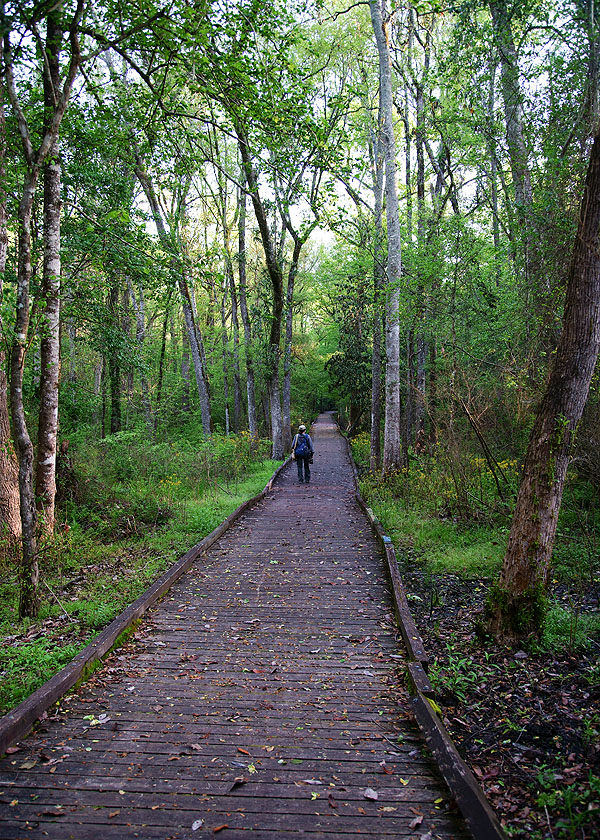
Birds called and sang in the canopy throughout the hikes, and occasionally they briefly left the cover of bushes or leaves for a brief sighting or photograph. We saw white-tailed deer, who bounded away at our approach as did the cotton tail rabbits. Mid-April means wildflowers, and we saw some absolutely beautiful displays. Boardwalks cover the wetlands area, where dragonflies fly by, but the mosquitoes land so wear long sleeves or use bug spray. Most likely due to cool mornings no snake or other reptiles crossed our path.

Heavy rains for two days prior to our arrival meant large puddles on some of the trails, and muddy areas. For the most part we could bypass the puddles just off to one side or the other without needing to go off-trail.

Each morning we walked a different combination of the trails. We heard and saw the most birds on our short walk along the Turkey Oak trail.

We saved Gopher Tortoise Loop for the last day. We saw on the website that a prescribed burn took place the week before our arrival, and parts of this trail definitely looked like they were part of a recent burn. We walked in the morning, and saw a lot of Gopher Tortoise burrows but no tortoises. Since the morning started cool, late morning or early afternoon would have been a better time so see the them.

Me with hiking along with camera a daypack

We loved our walks each morning, saw a lot, and took a lot of photographs. This park will be a yearly stop for us from now on.

Reed Bingham State Park Georgia

After a wonderful but short visit last year to Reed Bingham State Park in Georgia, we decided to return with this park as our destination and spend some time exploring it.

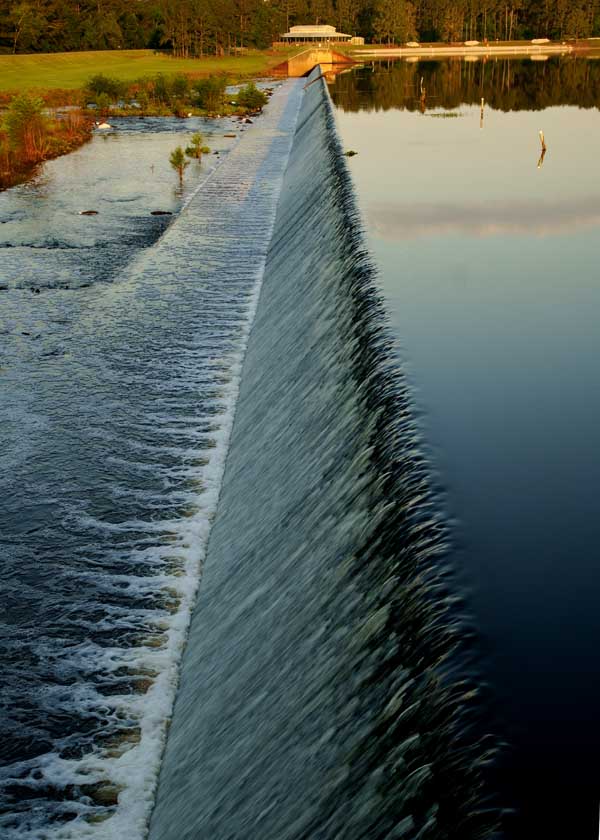
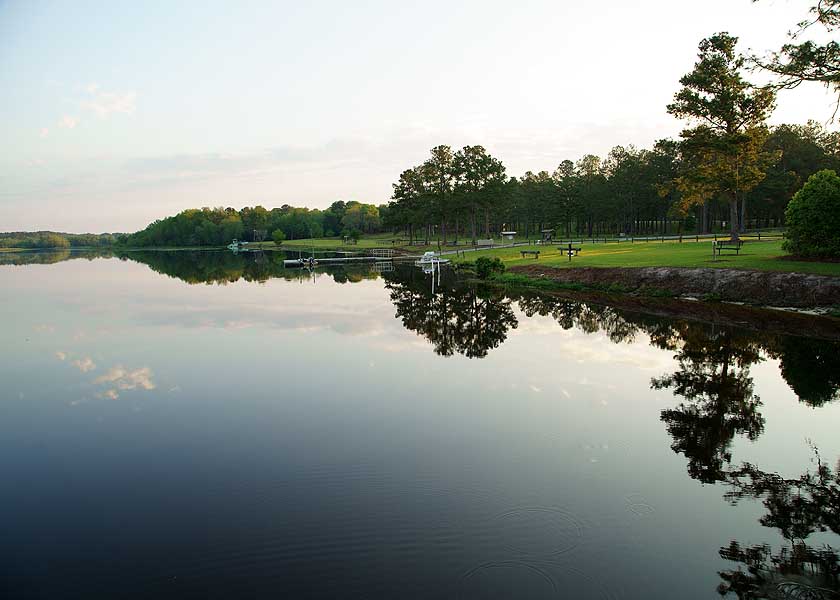
We came primarily to hike, but the variety of activities available impressed us. At the lake, people fished, kayaked, swam at a small, sandy beach area, and picnicked. The park contains seven miles of hiking trails, plus walking along the paved areas across the bridge next to the dam. We walked by another picnic area with a miniature golf course and a children’s playground. The Sunday we arrived families filled the picnic area, so seems to be a popular place locally.

For campers, the campground sites are large and spaced, and we saw a mix of tents, campers, and motorhomes. Electric and water come with the site, and some sites also have a sewer connection. The campground is a fairly open area, most sites are in full sun or partial shade but a few seemed to have shade most of the day. Everything appeared clean and well kept. Georgia makes reservations easy. They use Reserve America so you choose the park and then choose the specific campsite you want.
The weather cooperated for our stay. We drove through some heavy rain to get there, and it threatened rain the entire drive home, but we enjoyed cool mornings and sunny, warm afternoons the entire time we camped.

We loved all the amenities, especially our favorite the hiking trails. More detail on our hikes in the next post.

Finding the Common Yellow-throat

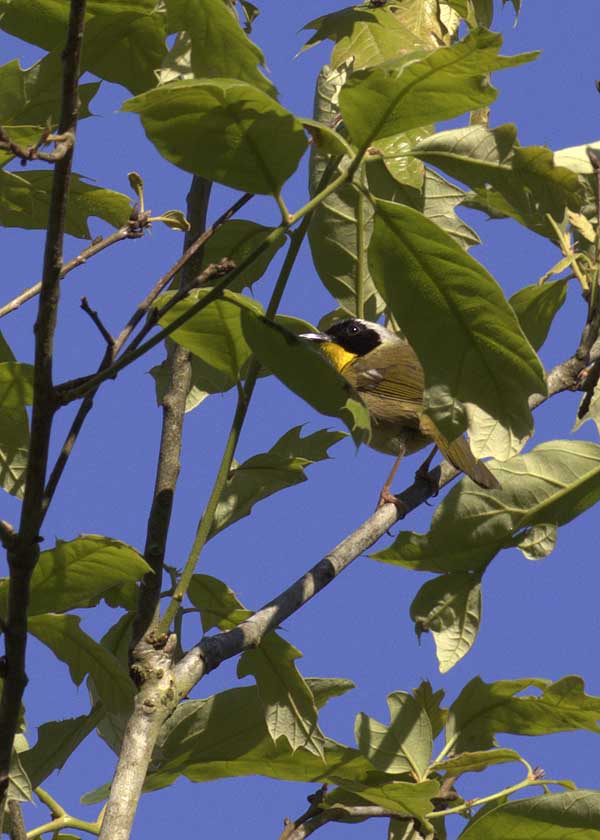
Most birds have calls and songs, so birding by ear can be challenging. During the birding we did for various citizen science projects I recognized the Common Yellow-throat warbler by its witchity, witchity, witchity, witch call. One spring a fellow birder, noted for his ability to identify birds by sound, called a Common Yellow-throat for the list. I asked if he heard the call, and he replied no, I hear the song. We waited and the bird sang again. I realized then that birding by ear involved a lot more than I realized.

On a recent hike I heard a loud bird song, repeated many times. I admit, I did not recognize it at all. Karl pointed in the direction he heard it, and I saw a flash of yellow in a tree. I approached carefully, and stopped, watching the tree. A few minutes later I heard the song again, then saw some movement. I spend at least ten minutes by that tree, listening and enjoying. Finally the bird showed enough of itself from behind a leaf for identification. I caught a photo of it looking at me, but when he sang he lifted his head behind the leaf, which blocked my view. All I managed to get is the open beak as he threw his head back to sing.

Lately we find ourselves doing more “slow birding”. When we birded for people or groups collecting research data, we followed their protocol and timing. We really enjoyed that time, and would like to do it again. But, we also really enjoy being able to stop and focus our time and attention (and camera) on one single bird.

Eagle in the Tree

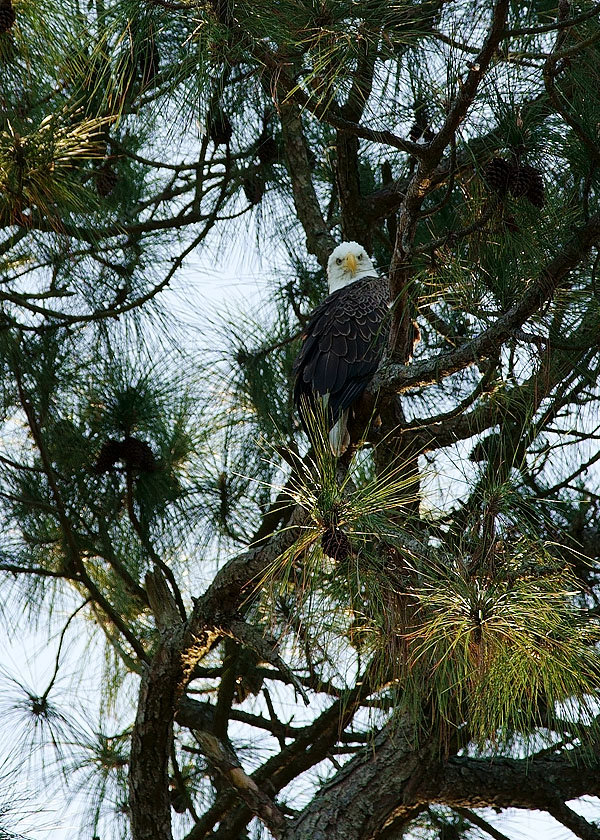
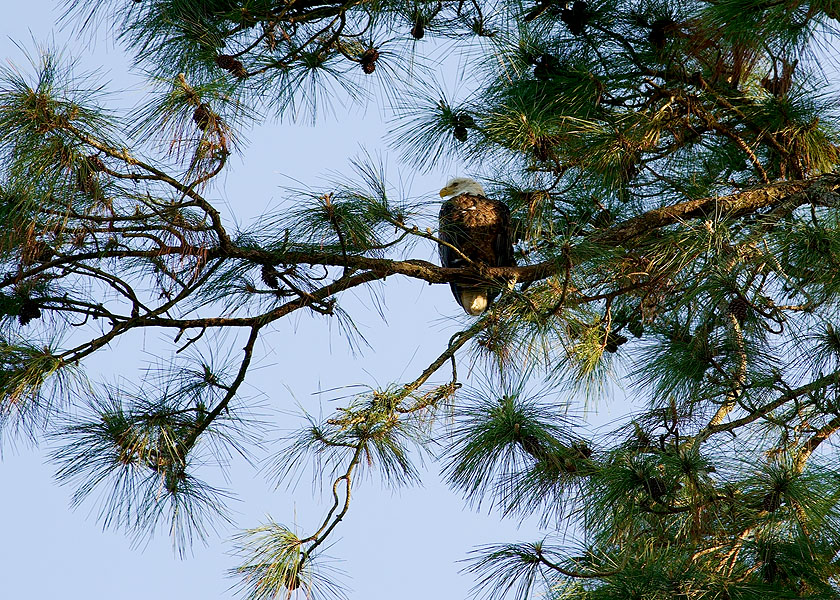
While walking through a local park recently, a fellow hiker stopped and asked if we had seen the eagle in the tree. We had not taken that side path and missed it, so doubled back and there was the eagle, exactly where the hiker told us to find him.

The light hitting his feathers was interesting, lighting up the two white feathers on the chest and the white of the tail. He remained unperturbed with the two photographers taking his photograph and watching him through binoculars. Karl continued to “work the scene” as we are always taught in photography courses, while I admired a Tri-colored heron walking by on the beach, also not too concerned about us. When we compared photographs, Karl definitely had the best one of the traditional pose in the tree, and captured one of the eagle looking down at us.

We try to let fellow hikers we see on the trail about anything interesting we saw, and appreciate when other hikers do the same for us.

Cormorants on a Pier

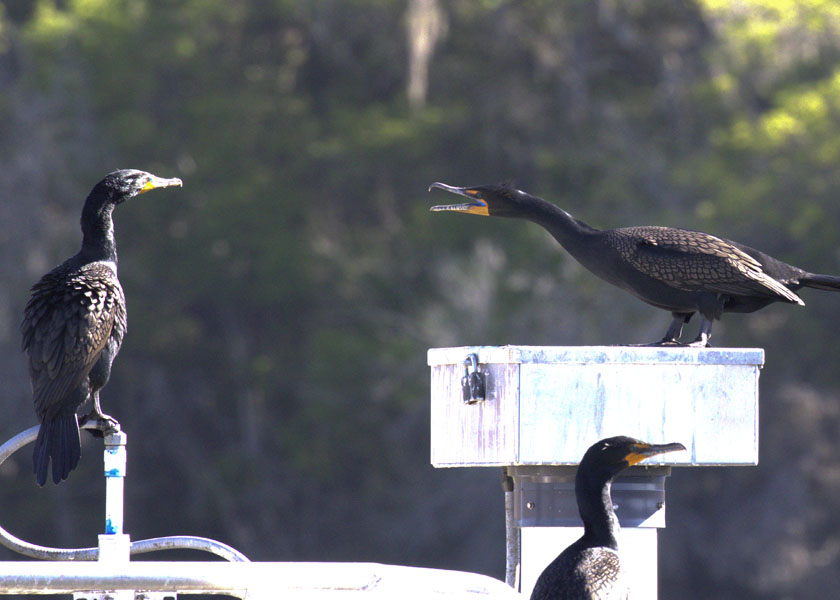
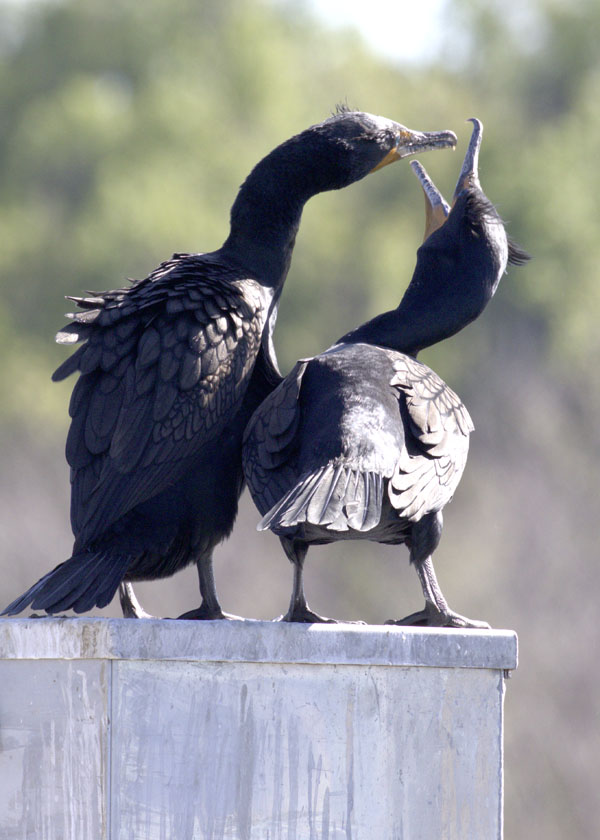
The cormorants sat quietly as we walked by this small pier. The collection of birds and sign caused Karl to stop and take this photograph. Never let an opportunity like this pass by.


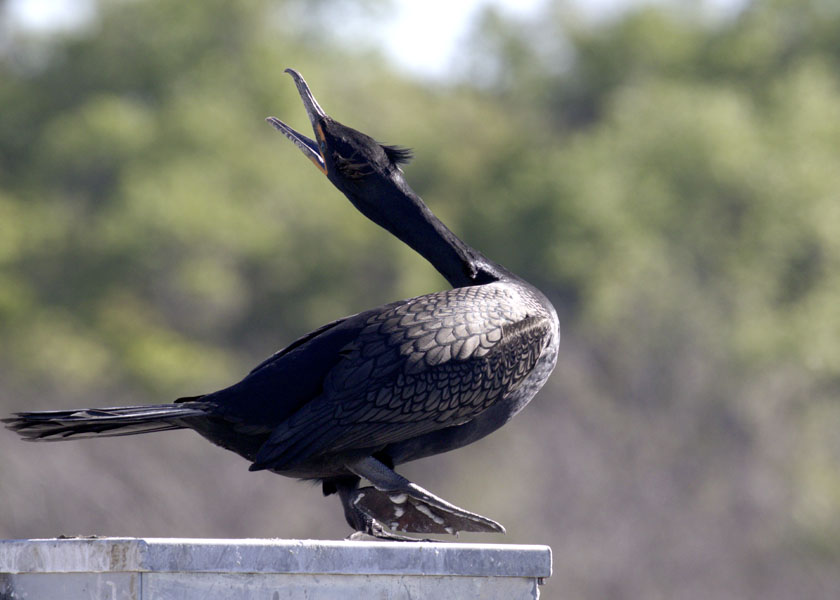
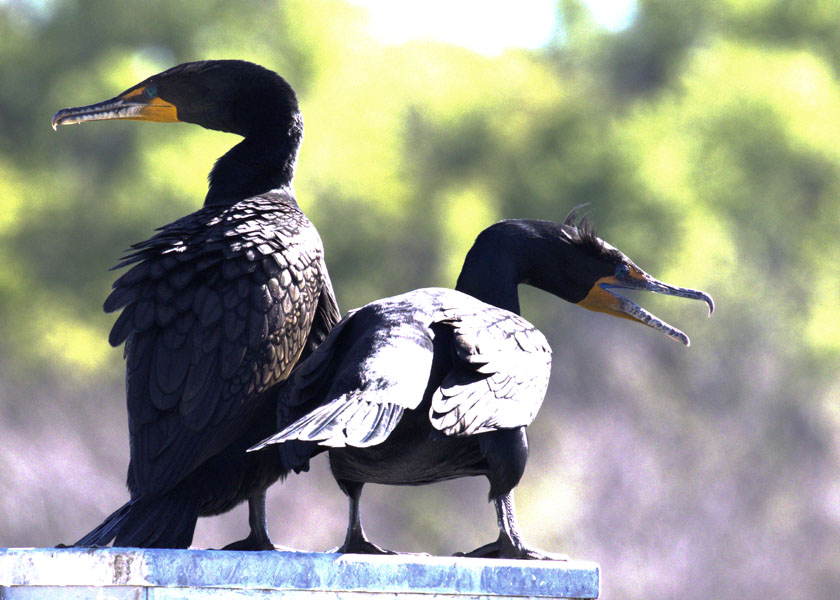
A little later we returned along the same trail, and heard one of the birds on the small pier making loud, constant calls. Usually described as gutteral, I saw one reference comparing it to the oinking of a pig. That bird definitely targeted the calling to one of the others on the pier, first directly at it and then winding its neck around continuing to call. As we watched, the other bird joined the caller, and the pair remained together as we continued our hike.

Two Calling Birds…

Spring definitely sprung this past week. We hiked Sweetwater Wetlands in Gainesville early one morning and birds sang and called constantly. This grackle sat nearly above my head on a tree next to the boardwalk. He sang and sang even as I photographed him.
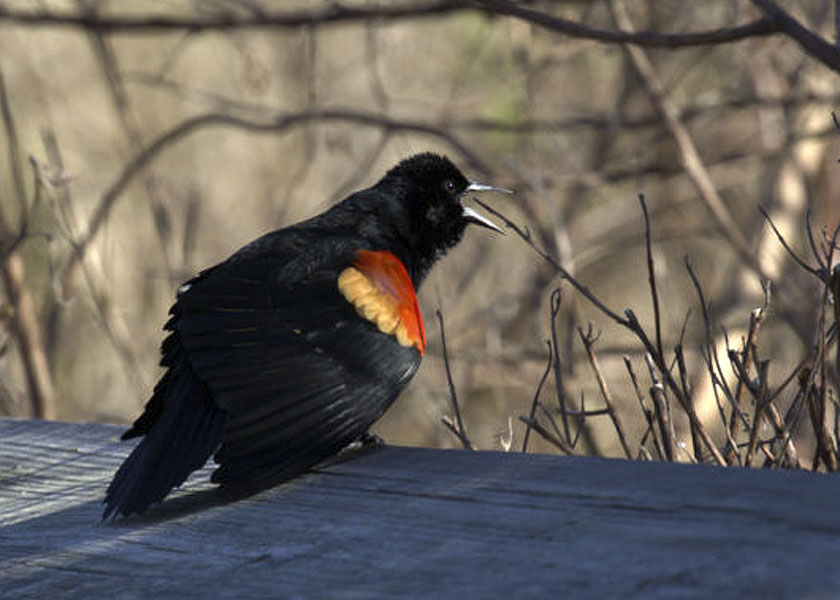
Some were clearly territorial squabbles. The Red-winged blackbirds, wings very bright in the sun, flew around each other, landing and chasing on this rail. As I watched, this male fluffed his feathers and expanded his chest, and let out his assertive call. The other males stopped bothering him, I guess he made his point.

We’ve had a cooler late winter/early spring this year. We found the weather nice and pleasant, but it certainly wasn’t the low 80s with a lot of sun that our winter residents and tourists expect.

Note: I had computer problems which led to me getting a new PC running Windows 10 as I was unable to find another using Windows 7. Unfortunately the graphics software I always used requires the cloud for most things in any version of it that runs on Windows 10. Since I need to be able to use the software offline, I am in the process of determining which software I can use. If any of you can suggest something that does not require a broadband internet connection, which we do not have when traveling and camping, I would appreciate it.

Alligators at La Chua Trail

Our last two trip to Paynes Prairie Preserve State Park we found the La Chua Trail at the north end of the park closed beyond the boardwalk due to flooding. We heard it opened so headed there this trip.
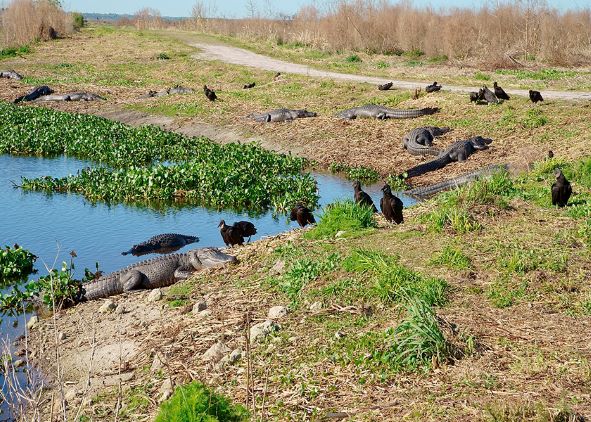
We walked the boardwalk and saw that area dried up quite a bit since our last visit. We continued to the end of the boardwalk and saw groups of people photographing ahead on the trail. The reason became immediately apparent. The cold night, which dipped into the 40s (F), gave way to a sunny and quickly warming morning. Near a small body of water, the alligators all swam up and beached themselves to enjoy the sun and warm their cold blooded systems.


The signs leading to the trail and just before that area warned of wildlife, and suggested keeping at least 20 feet from alligators, further from the bison and wild horses. The alligators rested in a large group across the small pond, but as we walked closer we realized that some of them also rested on the near side of the pond, right next to the trail. We passed as far away from them as we could, as did the other hikers.
We continued on when suddenly we heard splashing behind us. We looked and several of the large alligators plopped back in the water, sufficiently warmed and quite active. The other hikers continued, Karl and I decided to turn around at that point before they became even more active. Our prior experience on this trail prompted that decision.


Many years ago we spent nearly half an hour at a standstill on that trail. A large alligator plopped itself across the middle of the trail, in an area where passing safely on either side was impossible due to water. Several of us stood on one side waiting to get back, while many others stood on the other side, hoping to go forward. Finally the alligator decided to move and walked forward, sliding into the water.


We live in Florida and spend most of our time in natural areas. We see alligators all the time but always stay conscious of the fact that they are wild and can be dangerous. In general, they will move away from you if they can, so always give them an out and don’t stand between them and the water. An alligator becomes dangerous when humans feed it and they associate humans with food. They also become much more assertive during mating season, which starts in April.

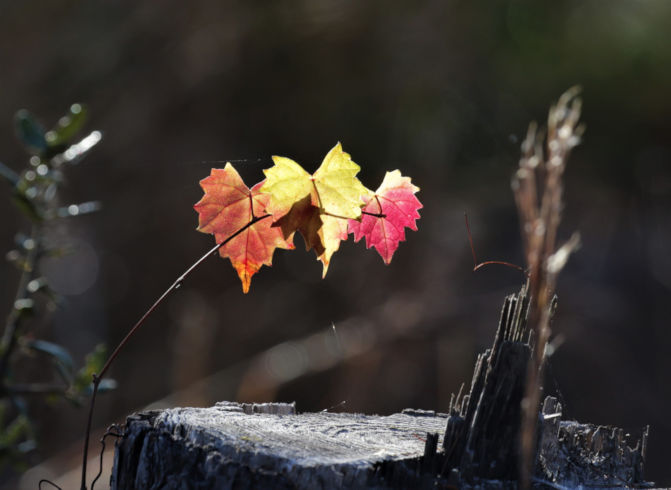
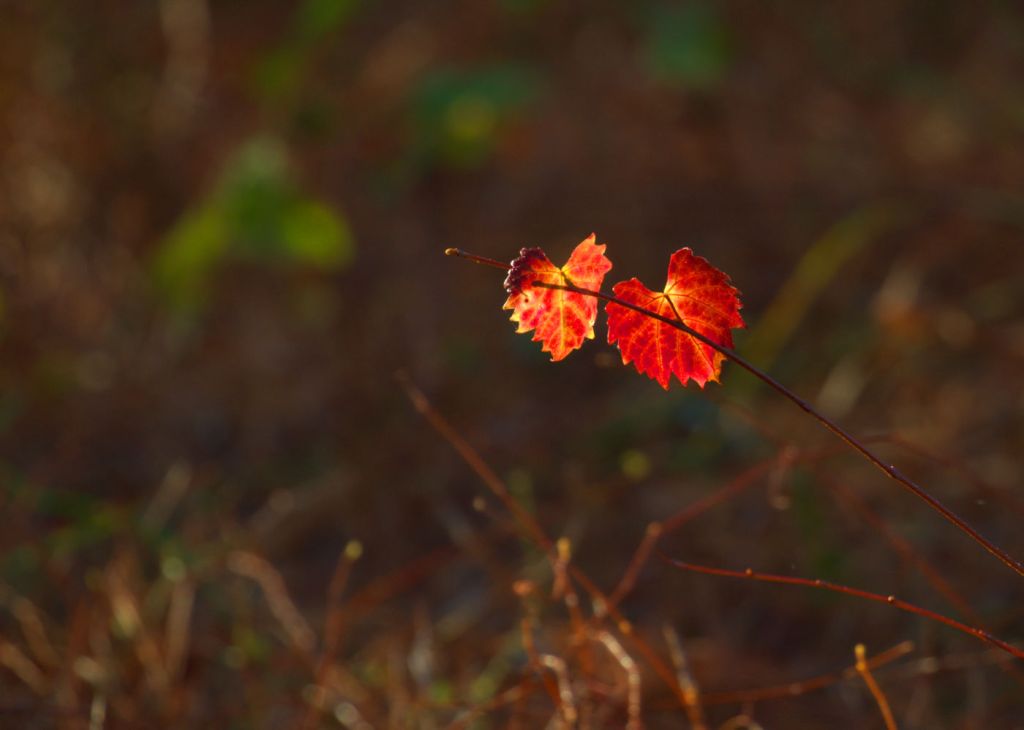
Vine Leaves in Early Sun

In autumn when the areas north of us boast trees with leaves of red, orange, and yellow so beautiful that people take trips to some areas just to see them, here in Florida we remain…well, green.

Many years ago after hearing people from elsewhere tell us Florida lacked two of the seasons, we developed a nature and photography program and hike to show visitors to our state that we too had autumn, and autumn changes, just more subtle. We pointed out the glowing purple of the newly ripened beautyberry, the gloss red of the wild coffee berries (scientific name Psychotria nervosa, with a name like that don’t drink it), some of the vines that do change color like the northern trees, including the infamous poison ivy and other changes. Nature let us know autumn arrived in a different way.


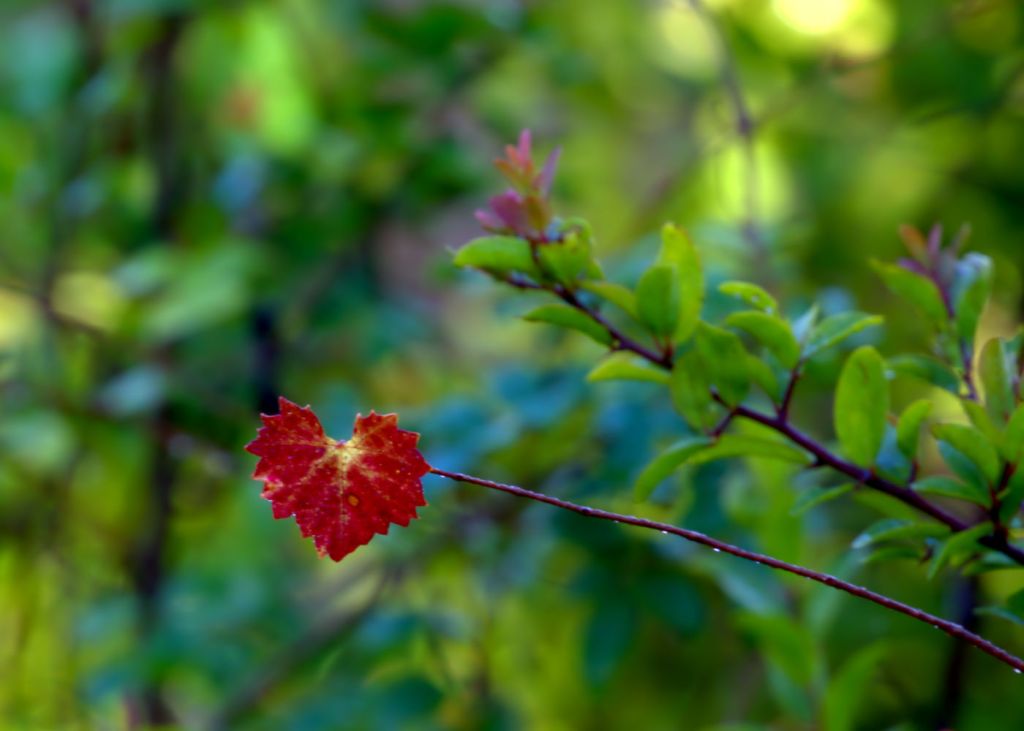
We hiked at Key Vista Park recently, and walking by a clear patch of ground along the trail I noticed that some of the vines still had some leaves remaining. Only one leaf, or maybe a few clustered along a small portion of the vine, still beautiful colors, and for a very brief few minutes with perfect morning sunlight coming through the tree canopy lighting them.