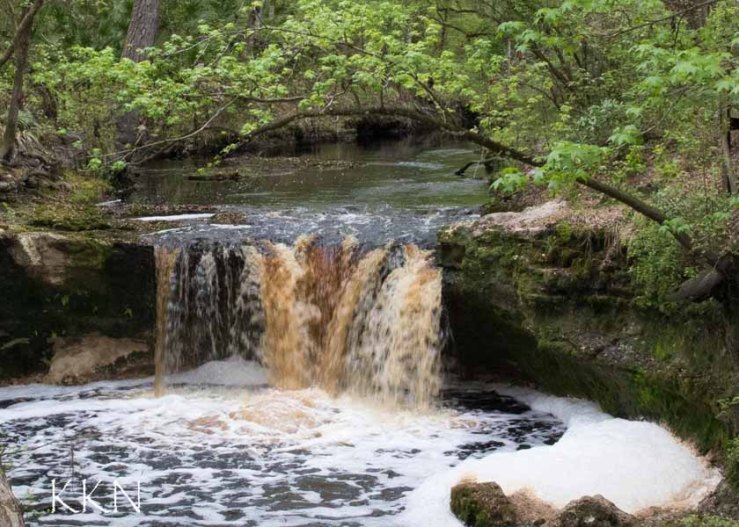
I worked with shutter speed at Falling Creek Falls during our visit (see last post). Neither Karl or I brought a tripod, so each shot was done either hand held or resting the camera on a fence or post to try for better stability. Karl hand held the shot on the last blog entry.
I set my camera on shutter speed control, not manual for this, and worked with various speeds. The first did not get what I wanted, and actually just makes the water look blurry to me. I shot, checked, decreased speed, and shot again for about 10 or 12 shots. The other two I posted below really produced some interesting effects, but I never got quite the shot I had in my head. The tanin in the water added a dimension that the same photograph on a clear creek or stream would miss, and I achieved that look but not the overall shot.
Because of the lighting and wind, I needed a tripod to achieve the shot I wanted. I plan to play around with the second and third shot in Photoshop with cropping to see what abstracts I can produce.
Some days, nature photography produces great shots, other days, all you get is some fun and a nice walk in the woods. But who is complaining about that…
Falling Creek Falls Park just north of Lake City, FL sat on our list for some time. As we travel, we keep notes and a travel journal as we see signs, interesting looking places or destinations, or someone comments on a local attraction. Each county, city, or town usually owns property used as public parks. In our travels we often find these parks, usually by accident. Incredibly, sometimes the locals do not know about them.
Our March RV trip proved much colder than the forecast predicted, with a north wind. Cold rarely stops us hiking and being outdoors just as the heat rarely stops us in July and August. The north wind this time of year in Florida, at least north and central Florida where we tend to migrate, really drops the “feels like” temperature, especially when it cuts right through you and is accompanied by cloudiness. We found the park, stepped out of the car, and the north wind greeted us. Not surprisingly, we found ourselves alone in this very small park on a not particularly great day.
For the first part of the hike on the boardwalk I heard only traffic from the nearby Interstate. It didn’t take long for that to fade away, and the rustling of the leaves from the many gray squirrels, and the occasional call of a bird to replace it. This winter central and northern Florida experienced a wet ‘dry’ season. We heard the muted roar of a waterfall before we reached it. Follow the boardwalk; it forks not far from the parking area and a sign points the way to the spur to the falls. We reached it in a few minutes. The water poured over the ledge down the ten feet to the continuation of the creek, and the tannin lent it an interesting color. We enjoyed it for a few minutes, photographed it from various angles, and then watched it a bit more. We returned the way we came, and walked the other spur to where the boardwalk ended and a trail went off into the woods along the upper part of the creek.
We both took the opportunity to play around with shutter speeds to see what effects we could get with the water and the tannin. More on that next week.
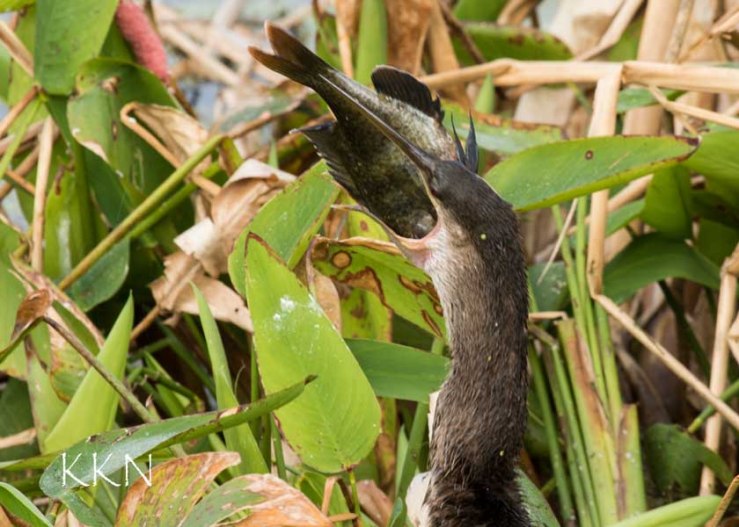
After numerous tries, he got the fish properly positioned and mouth opened wide enough
It took this Anhinga quite a while to position and eat this fish. I walked away briefly when it appeared he gave up, and came back to find him trying again.
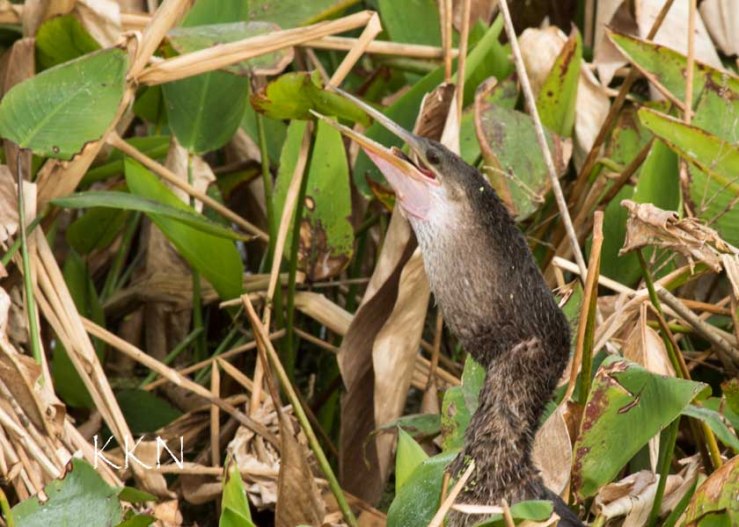
Working the way to swallowing slowly
I shot a lot of photographs to get these three. The fish wiggled quite a bit to try to escape, and the bird moved quite a bit to prevent escape, so focus and composition required a lot of patience and continual shooting.
While staying at Paynes Prairie and exploring the Gainesville area, we passed a sign on a couple of occasions that said Sweetwater Wetlands Park. I noted it, but with other destinations in mind we passed it by. A few weeks ago I researched it and discovered that this man-made treatment wetlands, a part of Gainesville Parks and Recreation, had hiking and birding. We decided to stop by one morning, and our brief stop took up most of the morning.
The useful brochure sized trail map shows three trails, called Wetland Cell1, Wetland Cell 2, and Wetland Cell 3, all with marked overlooks. Cell 1 contains an inner loop of a 0.4 mile boardwalk. We hiked only Cell 1, the inner and outer loop, and part of Cell 2 this trip, but found the trails wide and fairly flat. White boards at the welcome area and the start of Cell 1 listed recent sightings including wild horses. We spoke with a very friendly and knowledgeable ranger, who provided a great deal of information. She said that during Hurricane Irma a few members of the Paynes Prairie herd of wild horses came to the area, and the amount of rain then and subsequent higher than normal rain cut them off from the main herd. About six “hang out” in the areas of this park now, with plenty of grazing, and the rangers keeping an eye on them.
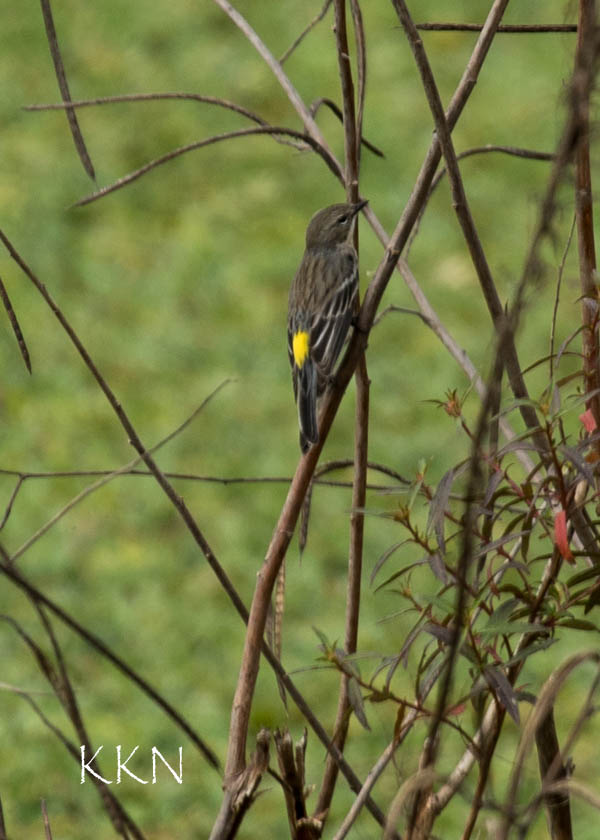
Yellow rumped Warbler, also called a “Butter Butt”. This photo shows why.
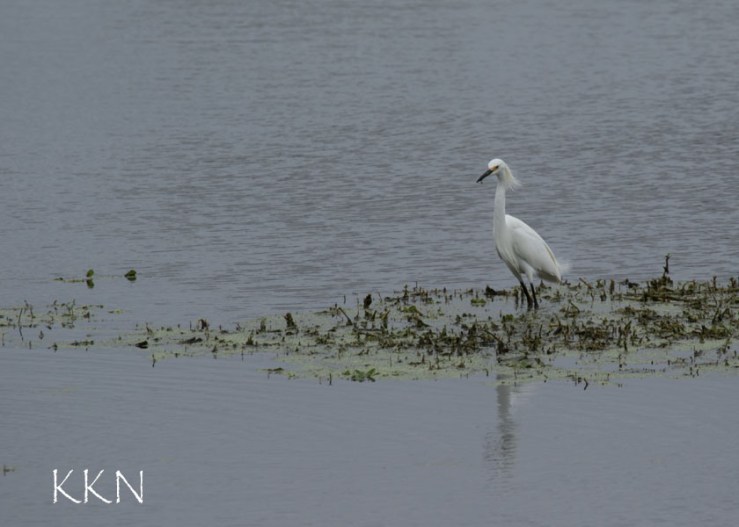
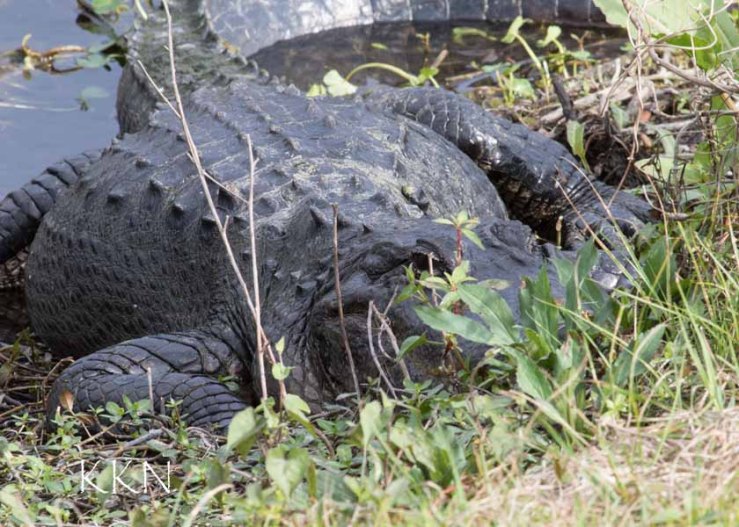
I recorded 27 species of birds in just the morning and only those I could definitely identify. A few maybes made the list, but unable to confirm they didn’t go to the final list. The trails circle the wetlands, well elevated above them in the parts we hiked, so many birds swim and forage quite close. I recommend binoculars and a zoom lens for the best experience. Several alligators rested in the sun along the edges of the water. Remember nothing restrains them, keep your distance and don’t feed or antagonize them. It surprises me how often I see people with their Smartphone camera looking at the screen while walking toward an alligator, snake or other wild animal.
With the zoom lens at 400MM. Believe me, I wouldn’t get this close.
The park opens at 7 a.m., seven days a week. The $5 parking fee payable at the entrance is well worth it. We plan to be back, and to get there earlier next time.
They quickened their pace a bit here, so we exercised caution and moved back
Until last week, our entire experience with the wild bison herd at Paynes Prairie Preserve State Park consisted of a glance through binoculars several years ago. Even with binoculars we saw only dark brown furry dots along a distant horizon. If the volunteer had not said they were the bison, we might never have known. Many people gave enthusiastic accounts of seeing them much closer every time we mentioned we were headed there, but in spite of visiting several times a year, we had yet to have that kind of luck.
Since Hurricane Irma, the prairie looks more like a lake, probably as it did in the 1800s when it was Lake Alachua. We hiked Cone’s Dike trail hoping for a glimpse of the wild horses, knowing from our last two trips that with the high water levels they often grazed along the trail. This time we walked along with very few sightings of anything, and just enjoyed the very pleasant weather.
As we turned a corner in the trail, we noticed two other hikers in the distance who appeared to be watching something. Through the binoculars, I saw some shapes. I thought they might be bison, but as with birding I was reluctant to call it until I was sure so decided to wait until we got closer. The couple headed back and we met them half-way. They said that others they passed heading back told them they had not seen anything, but as they walked along they saw the bison heading toward the trail. By then we saw the bison clearly through the binoculars.
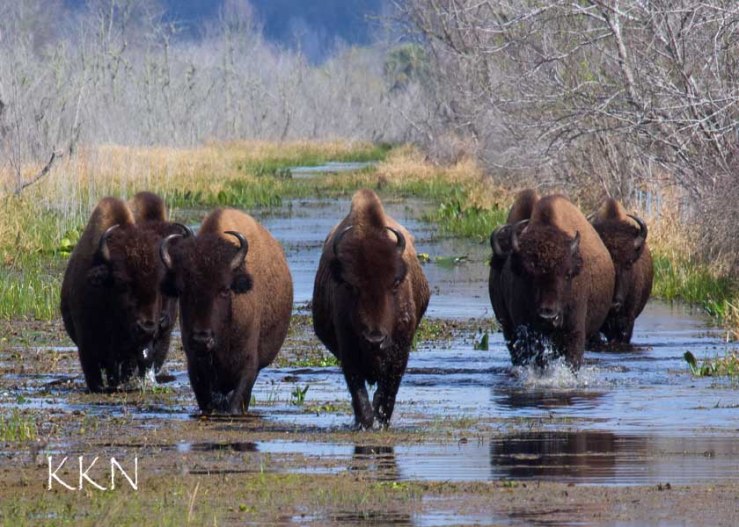
Bison all in a row
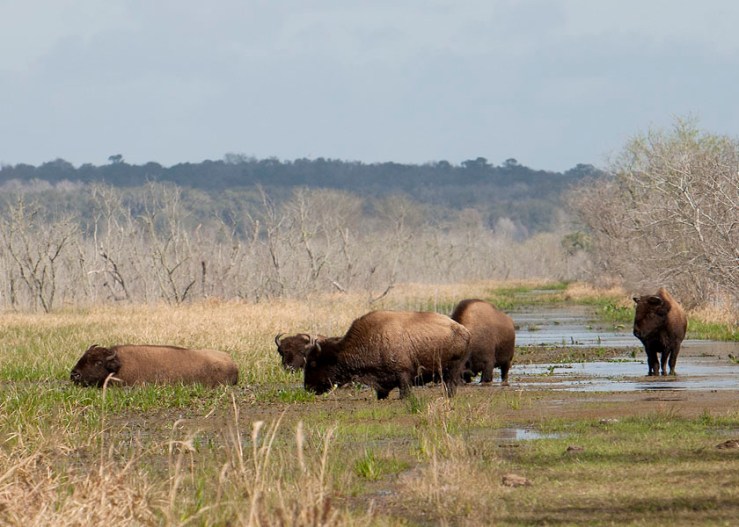
We walked a little closer, watching through the binoculars and taking photos with the long lens. At that point we realized that some were moving in our direction at a more quickened pace, and though a good distance still separated us we turned and walked away. A few yards on, I turned and saw that they had stopped, turned, and grazed. Karl stopped to take a few more shots.
Karl took this shot of the bison stopping to graze.
As we hiked back, we noticed other hikers walking toward us. All of them heard the bison were in the area and hoped to see them. I am sure the Internet is full of photos taken that day. For me, the awe of seeing them in real life was amazing.
Caution: We were not at close as these photographs suggest. All photos were taken at 200mm – 400mm. As with the horses, alligators, and all other natural residents of this area, they are wild animals.
A week of travel immediately followed by a week of house guests with other family visitors staying nearby resulted in no posts for two weeks. I need to start keeping my bullet journal again. It kept me on track, but over the holidays I ceased and look what happens!
A regular entry is coming next week, including our wonderful trip to Paynes Prairie State Park Preserve.
I took this photograph with the Canon 7D Mark II with a 24 – 70mm zoom, at about 45mm. With the ISO set at 100, I was able to get at 1/400 shot which froze the water in mid-air in spite of the very windy day. You can see the individual drops in the spouts of water and as they hit the pool.
We talked about this in our January class, and I didn’t feel I explained it well enough, so here is an example of using a fast speed on water to get the detail.
William H. Danforth Chapel, the only work of Frank Lloyd Wright on the campus in leaded art glass, and framed in native Florida cypress. Open to the public, it still contains the original pews.
Wright, at 70 years old, designed eighteen structures for the Florida Southern Campus from 1938 to 1958. Twelve were build during his tenure. He called the project the “Child of the Sun” with buildings rising from the ground and into the light. His organic architecture obviously inspired by the Florida sun and weather.
We heard about the structures that Frank Lloyd Wright designed for Florida Southern College many years ago. It languished on our list of places to visit. In the meantime, we visited Graycliff in Derby, NY and other Wright designs.
We took the RV camping in Lakeland a few weeks ago, and while we visited the Polk County Art Museum (to see the Degas drawing exhibit, very nice) on the Florida Southern Campus we discovered the buildings we hoped to see only two blocks away.
We took the self guided tour, which required some help from the occasional passing student, and had a wonderful time. Next time we are in the area we will definitely put aside time for one of the guided tours.
Karl took this shot of the Danforth Chapel. He worked with the light we had, not the light he wished we had, using the 5D Mark II with the Canon 24 – 105mm.
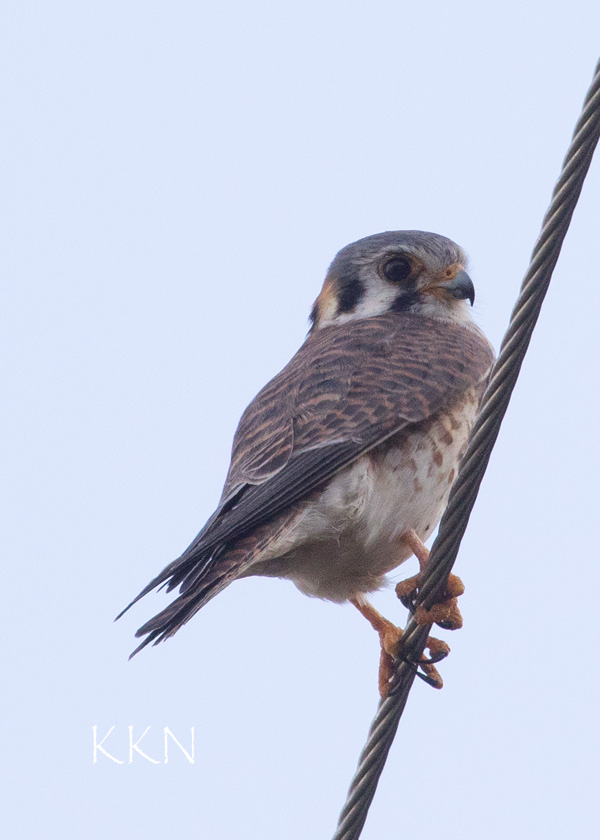
We did a little birding this past week. This guy caused confusion at first. The coldness of the day meant nearly all the birds puffed up and looked rounder than usual. In the blue-gray light, the colors were not at first obvious. This shot was taken at 400MM and cropped.
Tasty Tuesday produce. The small white flowers are on the Wasabi Arugula. Everything in the photograph is edible and locally grown.
Tasty Tuesdays, our local farmer’s market, began about five years ago. I found it by accident shortly after it started. I returned some library books and found the then small group outside the library. We started going every week, and watched it as more people became involved. Several growers moved on, one literally to another state where others now get to enjoy their wide variety of produce.
I grew a small garden many years every place we have lived, with varying success, mostly on the no success side. I found that where we are now an herb garden in large pots is about all that flourishes, I think in spite of me. My brother inherited my mother’s amazing talent for lush, productive gardens. I keep trying, with few results but a lot of determination. We eat a lot of vegetables, prefer fresh local, so Tasty Tuesdays makes my lack of skill in the area less noticeable in our daily diet. Our local growers often try new and different vegetables, and we try nearly everything at least once.
Many years ago I grew a great crop of romaine, a lot of it and all ready at the same time. I offered some to friends who visited one day, knowing that they ate a lot of salad and claimed to eat organic. They watched me pick it and reluctantly took it. What they thought I have no idea. A couple days later she called and said if we had any more they would take it, it was delicious! I knew they never gardened, and they depended upon chain supermarkets for their lettuce, buying California produce marked organic, so they never had truly fresh romaine. The difference in taste amazed them.
The photo above shows recent purchases from one visit. I got the idea for the photo looking at the purple and red radishes, and arranged it all in a basket immediately upon getting home. I used my Canon 7D Mark II, and an 85MM 1.2 prime lens. I did three sets of shots at varying distances, angles, and apertures. I thought I had THE shot in the second set, but after looking at it decided to try one more time. This shot, in the third set, used the kitchen lighting and an aperture of 2.8.
“Working the scene” is a phrase used by photographers all the time, and this is a good example of continuing to work even though you think you might have it.
And I didn’t buy the radishes or anything else just for the photo, we ate it all!







 Nichter Photography PLUS