For over a century a covered bridge named Coheelee Creek Bridge spanned the Coheelee Creek ten miles southwest of Blakely, GA. To find this amazing relic from the past, be sure to pick up a brochure with directions at the Chamber of Commerce. The bridge remains well-hidden in a beautiful, quiet, and scenic rural area. According to an article by David Williams of Valdosta State College, few covered bridges were built in this part of Georgia. This is the only one located south of Macon, making it the southernmost covered bridge in the United States. Built in 1891 in the queen-post modified style with a central pier, the bridge crosses the creek at 96 feet in length. In 1976 it was placed on the National Register of Historic Places, and restored by 1984.
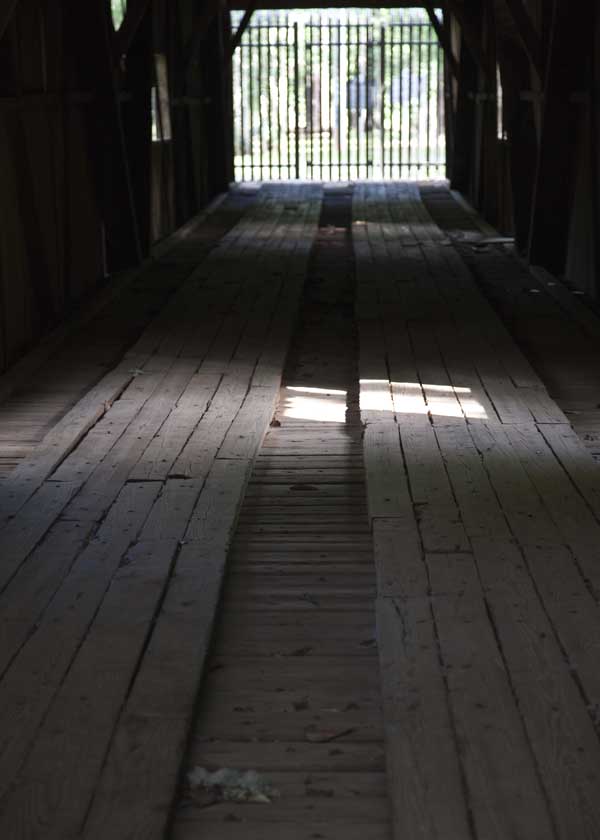
We discovered the existence of this little known bridge accidentally. We stopped at a store and found the brochure with some other local information. The driving directions in the pamphlet provided by the Chamber of Commerce made finding the hidden bridge easy. The sun came out as we admired and photographed the structure. We took our time. The contrast when the sun came out made photographing the inside a challenge. Karl set up several shots to get the tricky lighting to cooperate, and got this shot.
We find the most interesting and amazing things when we visit an area and just slow down, look around, and wander around.
On our recent trip to Georgia we took a back road to find the only covered bridge left in this area. We found the bridge, and enjoyed exploring and finding different angles to photograph it. As we walked back to the car, I started noticing the butterflies. Pursuing one in an attempt to get a shot, I realized not only did butterflies surrounded me, but they included many different species.
Because I had been photographing the bridge I had the Canon 24 – 70 mm lens rather than my butterfly photo preferred Canon 100 – 400 mm. That meant getting closer, and watching my shadow as I approached. Had anyone but Karl been watching me, I am sure that they would have wondered what I was doing as I stepped carefully, stopping and shooting, then continuing, sometimes ducking one way or another.
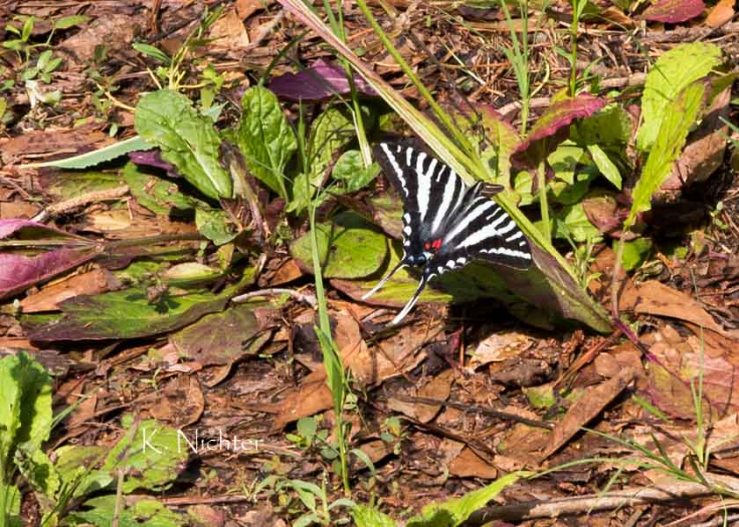
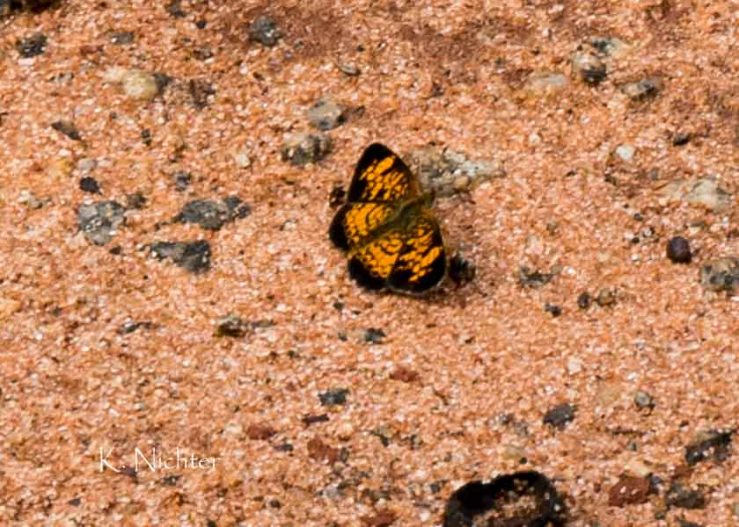
The Zebra Swallowtail above eluded me for many years. Usually by mid-morning they fly and flit hardly stopping in one place before going for the next. I took many shots of them in flight, this is the first one of one resting. The Spice-bush Swallowtail flew more leisurely, and stopped longer. The Pearl Crescent varied, and so many individuals flew around the area subjects at rest were easier to find. Numerous blues covered the area, but between flight, background, and their smaller size I did not manage to get the shot I wanted.
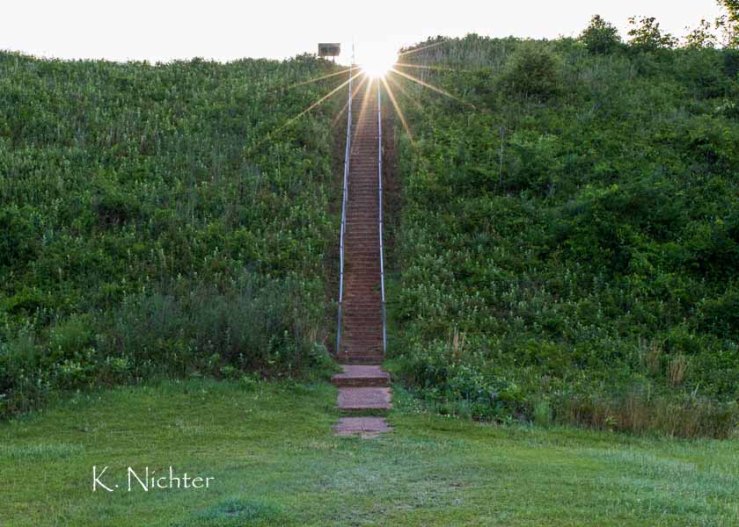
Sunrise on May 14, 2019, 8:07 a.m. at Mound A also called Temple Mound
This mound at Kolomoki State Park in Blakely, GA rises 56 feet high and measures 325 x 200 feet at the base. A visit to the museum at the Visitor Center provides much information, or as much as archeologist know at this point, about this mound, the others in the area, and those who build it.
Constructed over 700 years ago, and surrounded by villages, burial mounds, and a ceremonial plaza, it was a center of population in its time. It likely also served as a meeting or ceremonial center for the nearby cultural centers.
I managed to get to the mound only a couple of minutes before the sun peeked over it. I centered my shot directly at the stairs, and the sun is nearly directly at the top. I suspect on the summer solstice in June it would be in the center. I had time for two quick shots before the sun completely appeared.
We decided to try to camp at Kolomoki Mounds State Park again. Our first trip there, two years ago, coincided with Hurricane Irma. We checked in late because of the evacuation traffic on US 19 and set up the RV at site 18 only to learn the next morning that the hurricane turned and the forecast called for it to hit the area. After an hour on the telephone with a wonderful customer service person at Choice Hotels, we finally secured a room in Alabama and left the next day. When we checked in this trip we told the ranger the story, and he said we should have stayed. It turned again, as we knew, and their full campground, sold out the two nights we stayed mostly with fellow Floridians escaping the storm, emptied out as everyone left due to the new forecast. The second trip never happened. Hurricane Michael came right over the park a week before our reservations, and closed it for a few weeks. Two trails remain closed and need to be cleared.
We left on an overcast but pleasant Sunday morning, Mother’s Day. The new anti-sway bar installed the week before made a big difference in handling and in the ride. As we headed north on U.S. 19, the clouds began building ahead. We crossed into Georgia, and had a few drops of rain around Thomasville. We turned to head west on US 84, and the sky in the distance looked very threatening. Just outside of Bainbridge, GA we hit the line squall. We actually saw it coming. Suddenly the trees ahead swayed and bent, leaves and pine needles swirled in the air, the rain started and we felt it hit the RV. With no place to pull over, everyone slowed. The rain fell hard and considerably reduced visibility. We found our left turn and continued, the wind eased after the first hit and the rain, while heavy, backed off somewhat. We continued toward Blakely and the park.
Upon arrival at the park, the ranger met us in the parking lot. The line of storms we just drove through had knocked out their electricity. We went to our campsite without checking in and the ranger promised to stop by and let us know when the electric came back. We set up, and not knowing how long it might take to restore the electricity we decided to conserve the house batteries as much as possible so pulled out our battery-operated lantern, camping French Press and kettle, and solar phone charger. As we still had overcast skies and occasional rain, the latter item would not be put to use immediately. Our RV stovetop runs on propane, and we carry a two-burner propane Coleman stove to avoid heating up the RV on warmer days. Two hours later the ranger stopped by, we had electricity.
What I saw when I looked up!
The campground sits on the shore of Lake Kolomoki. We prefer a site away from the water, near the path to the park. From our site we see the lake, but have plenty of shade and privacy. Several other campers joined us for one night, and went on their way the next day so for the most part we had the campground to ourselves. One afternoon I took my camera and notebook and sat at the picnic table at one of the empty lake front sites. I glanced up from my writing to see a snake watching me from only a foot or so away. I never noticed it coming. I slowly grabbed the camera, backed off a bit, and took a couple of shots, When it didn’t move I gathered my things and giving it plenty of room left and walked back to our site. The ranger looked at the photograph later and said it looked like an Oak snake, also known as a Gray Rat Snake. They average 5 – 6 feet, but can be up to 7 feet. This one I think was about four feet.
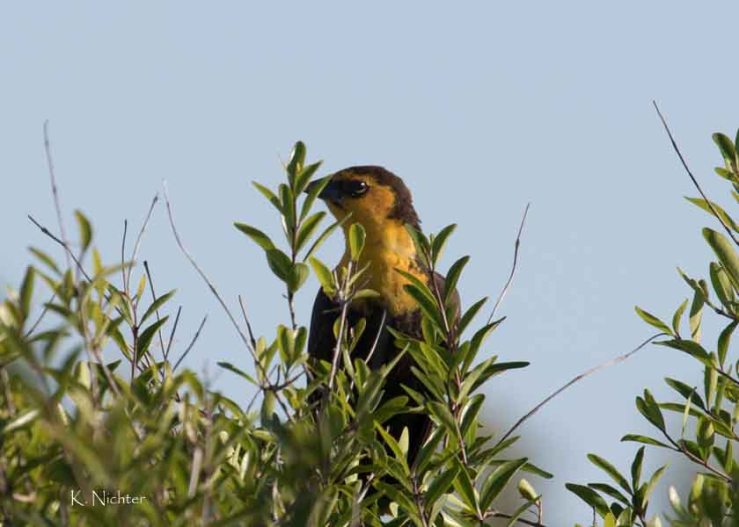
Barb and I finally saw the Painted Bunting Male, along with many females on our third day, this time at Honeymoon Island. Mark and Karl saw one our first day that we missed. Our big surprise: A Yellow-headed Blackbird in a shrub along the path to Bet Beach. This species makes very rare appearances this far east. Luckily I managed several good photographs, and a local birder confirmed the sighting. I tried to post to both eBird and Birdbrains, and though a member of both neither site would take the photograph.
From the third day:
Female Painted Bunting eatingFemale Painted Bunting flying away, Male standing in background to left
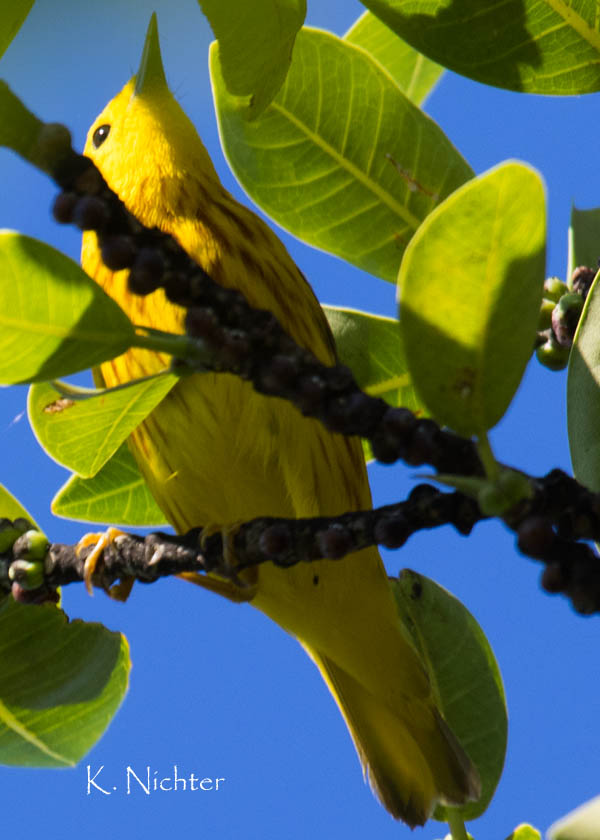
Our drive to Fort DeSoto takes well over an hour now due to traffic. We make the sacrifice in time and sanity once a year because of the migrants that it draws. Some of the highlights from the day: Summer Tanager, Scarlet Tanager, Black-throated Blue Warbler, Black-throated Green Warbler, Tennessee Warbler (lots), Yellow Warbler, Orchard Oriole, Baltimore Oriole, Dickcissel, and many others that went by too fast.
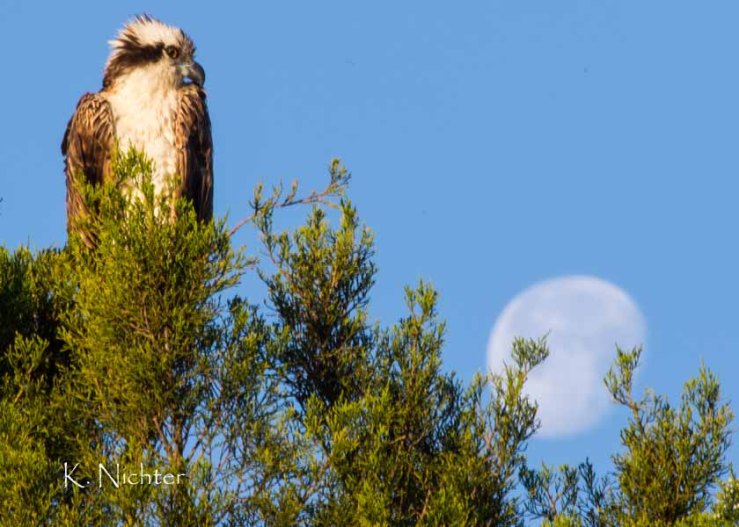
Osprey at Eagle Point Park with moon in background
Twice a year, our part of Florida watches closely for the migrant birds that pass through on their way either north for the summer or south for the winter. This year we visited several places along with family, who also bird. Quite a few migrants stopped this year due to a weather front, so we went with high hopes.
When I bird, I also photograph. Often I photograph for identification confirmation more than for art or science, but occasionally the birds cooperate well enough (or feel sorry for me?) that I manage both. We saw birds, but not many migrants at Eagle Point Park, Green Key Park, and Key Vista, our hiking on the first day. The second day at Fort DeSoto yielded the best migrant count, and also the best migrant photography. Our third day together at Honeymoon Island provided some birds, and quite a surprise.
My bird lists, as usual lately, ended up incomplete and sparse. Juggling the binoculars and camera I often think I will remember all the species. I don’t. I also lose my pen or pencil frequently. Fortunately Karl usually sees me drop it and tells me. Too often, mostly with the expensive waterproof pens or mechanical pencils, I drop them and we never find them. After returning from these wonderful three days of hiking, I decided to make my note taking easier for me and the pens more likely to stay put. Women’s hiking pants rarely have pockets suitable for the notebook and pen, as most men’s do. I am trying a new system and will report back if it works.
From the first day:
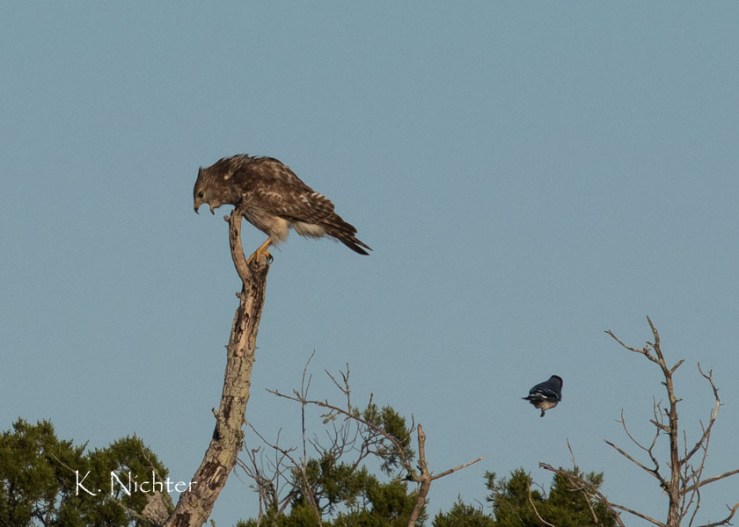
Hawk near a nest being harassed by the Blue Jay making a hasty retreatRose Breasted Grosbeak at Key Vista, one of our few migrants the first day
We saw spring flowers, plenty of dragonflies, some of whom even stopped long enough for a nicely posed shot, a hawk sighted by one of our sharp eyed regular hikers, and near the end a juvenile Black-crowned Night Heron who sat in a tree for us.
Thank you to all of our hikers. We love these hikes because we meet such interesting people, and we all learn from each other. Our next event will be another workshop style class in July. We scheduled this recently after the positive feedback from the January program and after discussion with the staff at Brooker Creek Preserve. The workshop starts with a short basic photography presentation, followed by questions from you. Bring your camera and any questions you have about the camera or using the settings, we do our best to answer them. We hope to see you there.
For next season, we plan to stay with the program of two hikes in the Fall (October and November) and two in the Spring (March and April) with a workshop style class in January. We do not charge for the hikes or the classes, they are part of our volunteer work in support of Brooker Creek Preserve.
We have guests this week, and they love birding as we do. We are off hiking for the week. Next week I hope to have some interesting bird photographs to share.
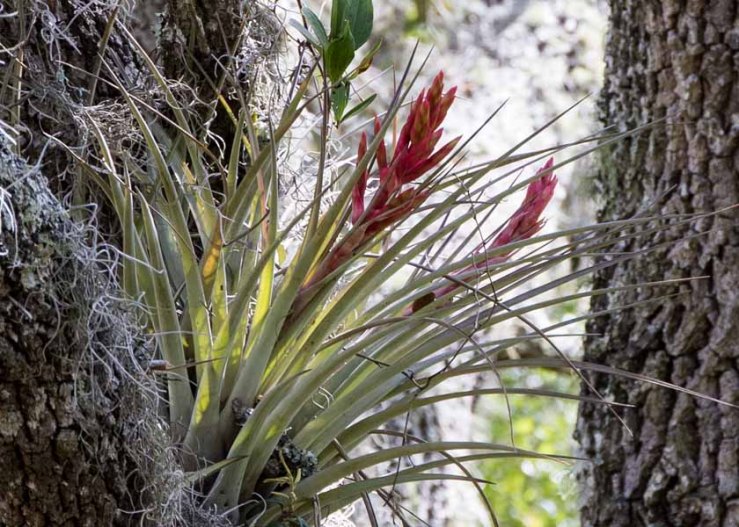
The Mexican bromeliad weevil (Metamasius callizona) entered Florida through imported plants in the late 1980s. By 2009 it spread to most of south and central Florida. We once saw this plant, the Cardinal Flower, frequently on our hikes in this area.
This is the first one of this size we have seen in years. When the botanist pointed it out to us, slightly off trail, we all were excited to see it. I believe as a result of the weevil, called the “Evil Weevil” by bromeliad lovers, the T. fasciculata along with the Giant Air plant (Tillandsia utriculata) are now listed as either threatened or endangered.
It is amazing how quickly an insect inadvertently moved from its native area to a new area can affect the native flora, unfortunately negatively in this case.









 Nichter Photography PLUS